Read the Article
The full text of “Quarterback Play in the Triple Option” by Greg Webster — Offensive Coordinator, Springfield College, from the Vol 1 — 2018 issue.
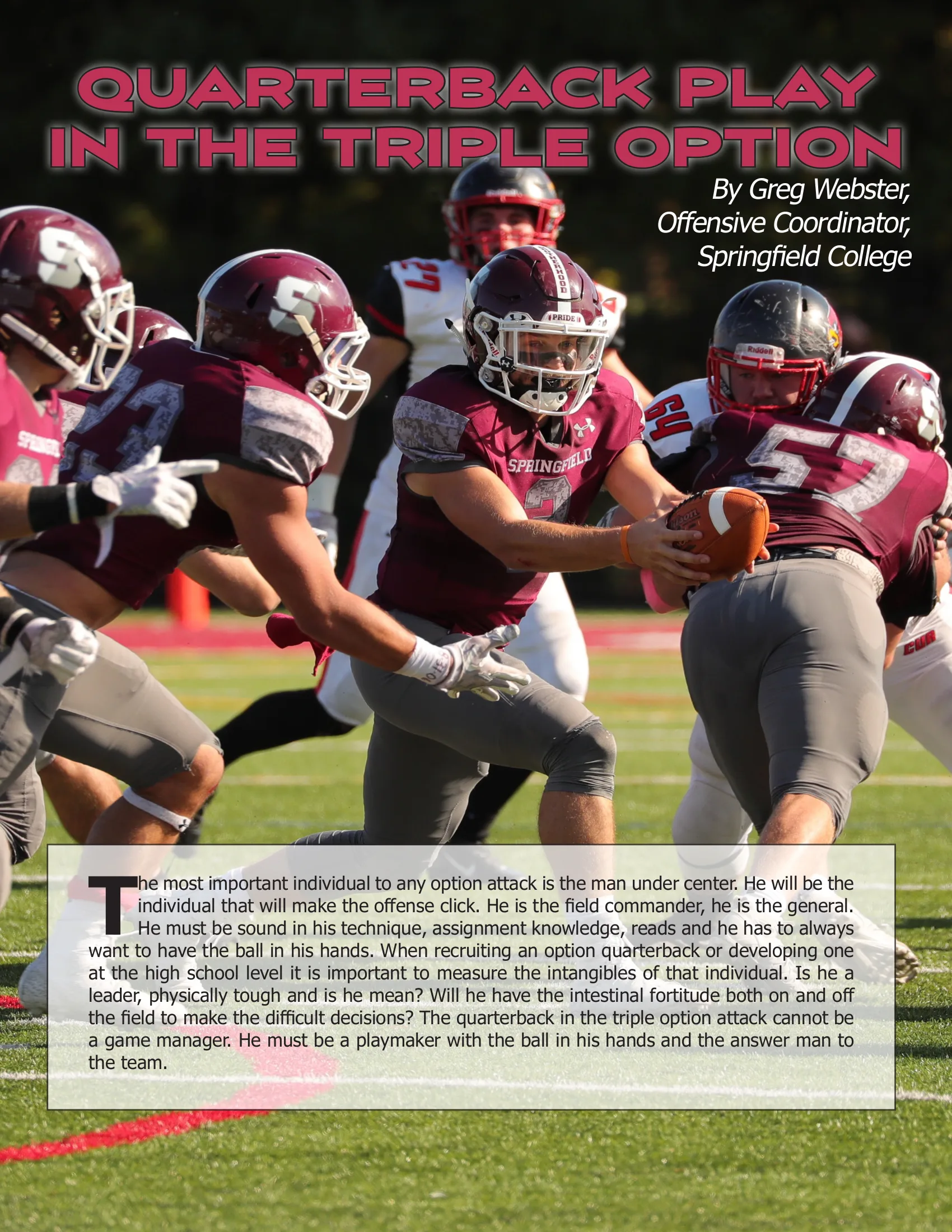
Page 22T he most important individual to any option attack is the man under center. He will be the individual that will make the offense click. He is the field commander, he is the general. He must be sound in his technique, assignment knowledge, reads and he has to always want to have the ball in his hands. When recruiting an option quarterback or developing one at the high school level it is important to measure the intangibles of that individual. Is he a leader, physically tough and is he mean?
Will he have the intestinal fortitude both on and off the field to make the difficult decisions? The quarterback in the triple option attack cannot be a game manager. He must be a playmaker with the ball in his hands and the answer man to the team. Quarterback Play in the Triple Option By Greg Webster, Offensive Coordinator, Springfield College
Page 23W hen initially teaching the offense to any quarterback, one must always start with the philosophy and perimeter counting system. This is the basis for our option attack and the quarterback must know and understand it. We preach to our quarterbacks the idea of numbers, grass and angles. Numbers - run to where we have the numbers advantage; grass - attack the alley never attack a man; angles - create advantageous blocking angles on the perimeter.
It is important that the quarterback understands our philosophy and perimeter count system so that he can put us in the best position to succeed. It is of utmost importance to install an attack mindset to the quarterback. We call the play, we set the perimeter and we set the tone. The defense will align based off of our formation and will play based off of our tempo. The quarterback must have this mindset. He must be the man who sets the tone for our offense and leads the attack verses the opponent’s defense.
He must think of the defense as bodies on the perimeter, apply our count system and attack. Like any quarterback in any offense, the quarterback must always be aware of his surroundings.
As he walks up to the line of scrimmage, he must lighthouse the defense and know: • Down and distance • Time on the play clock/game clock • Score • Quarter • Situation • Defense alignment • Defensive techniques • Perimeter count to both sides (can we audible based off an advantage?) It is especially important for the quarterback to know and understand all of these variables when it comes to our audible system. We will give the quarterback as much freedom as he can handle to check plays at the line of scrimmage.
This enables us to get into the best play possible based off our philosophy of numbers, grass and angles. None of this is possible, however, if the quarterback is not aware of the game situation and defense as he approaches the line of scrimmage. Stance and Exchange With the quarterback’s stance we teach a narrow base (inside the framework of the center) with the weight on the balls of his feet. His feet are slightly pigeon toed which enables him to burst out of the exchange.
He will have his mental weight on his drive foot. For example, if we are running a play to the right, the quarterback will think of loading his weight and driving off of his left foot out of the exchange. When coming under center, his throwing hand will be wrist deep with the fingers spread naturally while his non-throwing hand comes under and joins at the thumb’s natural groove. He will have a slight bend in the elbow of his throwing arm, his knees will be bent, and his hips sunk; Z’s in the hips, knees and ankles.
As the ball is snapped he will apply pressure with his bottom hand and he will push the top hand into the bottom palm. The center’s feet will be slightly wider than shoulder width to allow the quarterback’s feet to be inside of the center’s. As the ball is snapped the quarterback will apply pressure out and up on the center’s butt with the heel of his bottom hand and ride with his top hand.
As the center snaps and steps, the quarterback will ride the center and move his hands forward as his non-throwing hand closes on the football. It is essential that the center’s back stays flat at the same height that he initially began.
Page 24Once the quarterback possesses the football, he can execute the proper series technique. A good teaching aid to ensure that the quarterback has a narrow stance when under center is the use of a PVC pipe box. That is, when executing any quarterback center exchange in pre-practice or during certain drills throughout practice where a full offensive line is not present. This also helps for the quarterback to get away from the line of scrimmage and get the ball as deep to the fullback as possible.
Reach Ride and Execution of the Dive Read When running the inside veer we have an inside track with the fullback and a toe replace heel step with the quarterback. If we are running veer to the right the quarterback’s left toe will replace his right heel and the back of his heels will be in-line with the original foot placement of the center while the ball is on the inside leg of the playside guard. To drill this during pre-practice, have the center face the sideline with his playside foot directly on the goal line.
When the quarterback disconnects from the center, the back of his heels should align with the goal line. When executing the insider veer steps, the quarterback must get away from the line of scrimmage and get the ball as deep to the fullback as possible. The deeper the ball is to the fullback, the longer the quarterback can ride the fullback into the line of scrimmage. This will become important when we discuss key manipulation by the quarterback.
The quarterback’s hands must beat his feet (use a medicine ball to quicken his hands) and they must be a hip level and his elbows are fully extended. Once the quarterback reaches his hands back and the ball is placed in the fullback’s pocket, he will now ride the fullback into the line of scrimmage. Before we break down the ride phase, it is important to understand the pre-snap thought process as he approaches the line of scrimmage.
As previously noted, the quarterback must know the game situation as well as the defensive techniques and perimeter count. Once the quarterback understands the situation and has counted the perimeter, he will now determine the body language of the defender’s on the perimeter. This will allow him to have a pre-snap plan of whether to give or keep the ball during the ride phase. For example, how tight is the key? What foot is up? Is his weight forward of back? Is he titled or square to the line of scrimmage?
What has this key been doing throughout the course of the game? In film study? The better understanding the quarterback has of the key, the easier the read will be. The quarterback must have a plan as he approaches the line of scrimmage in order to anticipate any reads. Now back to the ride phase. Once the quarterback has the ball in the fullback’s pocket at hip level with his eyes on the dive key, he will transfer his weight from back foot as he rides the fullback into the line of scrimmage.
As he rides he will be on the balls of his feet and his feet will turn into the line of scrimmage at a 45-degree angle. The quarterback will never read past his front hip while the fullback must keep a large pocket and never clamp on the football. Fumbles in the mesh are caused by quarterbacks reading past the front hip or fullbacks clamping in the mesh. The fullback must trust the quarterback through the ride phase and the quarterback must be decisive, make a decision and go!
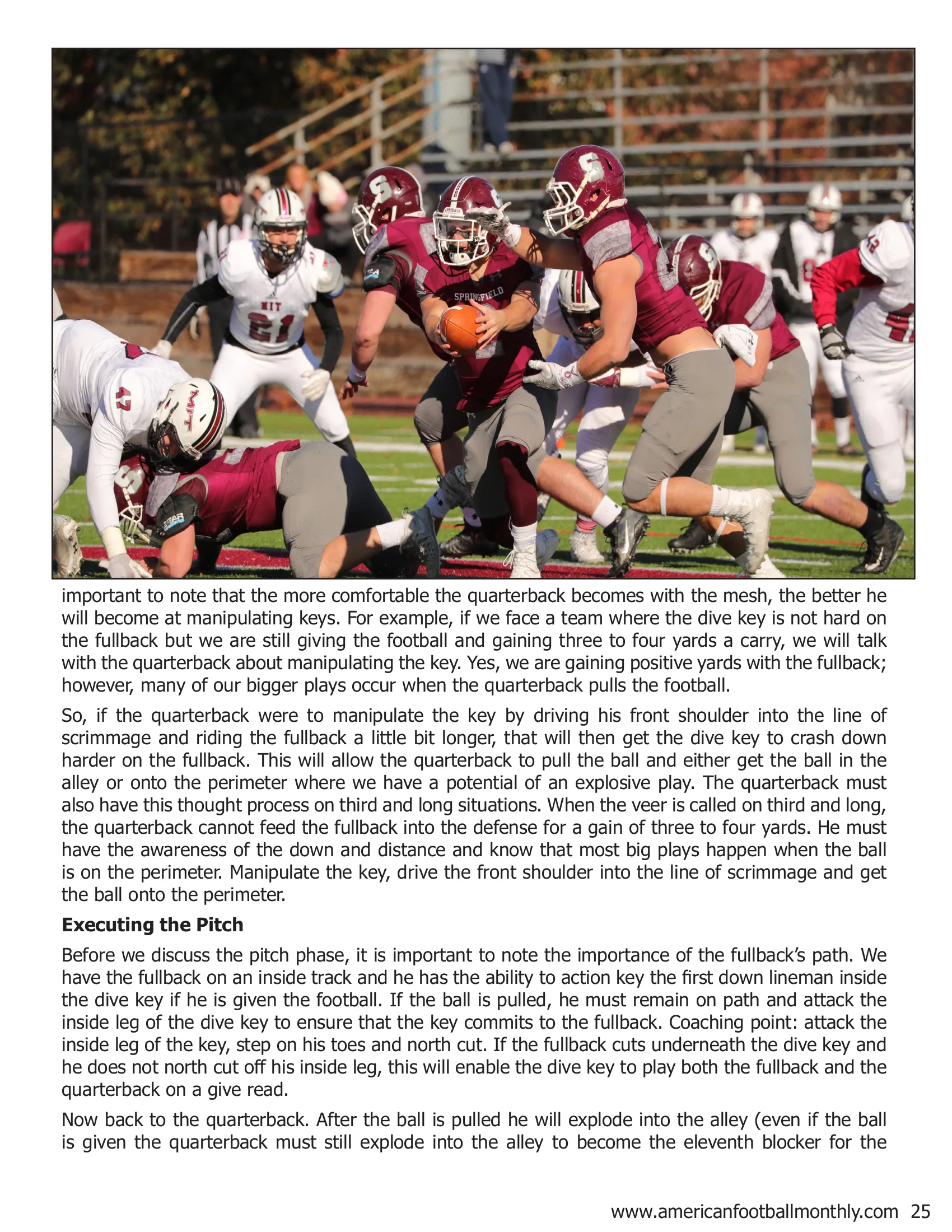
Key coaching points for the mesh: frontal pressure = give and side pressure = pull. When executing the read of the dive key think head behind give, head in front pull. Coaching Points: • Hands beat the feet • Arms extended, pin the chin • Reach, ride • Never read past the front hip • Be decisive • Miss the read, follow the fullback As stated before, we give the quarterback rules on when to pull and give the football. However, it is
Page 2525 important to note that the more comfortable the quarterback becomes with the mesh, the better he will become at manipulating keys. For example, if we face a team where the dive key is not hard on the fullback but we are still giving the football and gaining three to four yards a carry, we will talk with the quarterback about manipulating the key. Yes, we are gaining positive yards with the fullback; however, many of our bigger plays occur when the quarterback pulls the football.
So, if the quarterback were to manipulate the key by driving his front shoulder into the line of scrimmage and riding the fullback a little bit longer, that will then get the dive key to crash down harder on the fullback. This will allow the quarterback to pull the ball and either get the ball in the alley or onto the perimeter where we have a potential of an explosive play. The quarterback must also have this thought process on third and long situations.
When the veer is called on third and long, the quarterback cannot feed the fullback into the defense for a gain of three to four yards. He must have the awareness of the down and distance and know that most big plays happen when the ball is on the perimeter. Manipulate the key, drive the front shoulder into the line of scrimmage and get the ball onto the perimeter. Executing the Pitch Before we discuss the pitch phase, it is important to note the importance of the fullback’s path.
We have the fullback on an inside track and he has the ability to action key the first down lineman inside the dive key if he is given the football. If the ball is pulled, he must remain on path and attack the inside leg of the dive key to ensure that the key commits to the fullback. Coaching point: attack the inside leg of the key, step on his toes and north cut.
If the fullback cuts underneath the dive key and he does not north cut off his inside leg, this will enable the dive key to play both the fullback and the quarterback on a give read. Now back to the quarterback. After the ball is pulled he will explode into the alley (even if the ball is given the quarterback must still explode into the alley to become the eleventh blocker for the
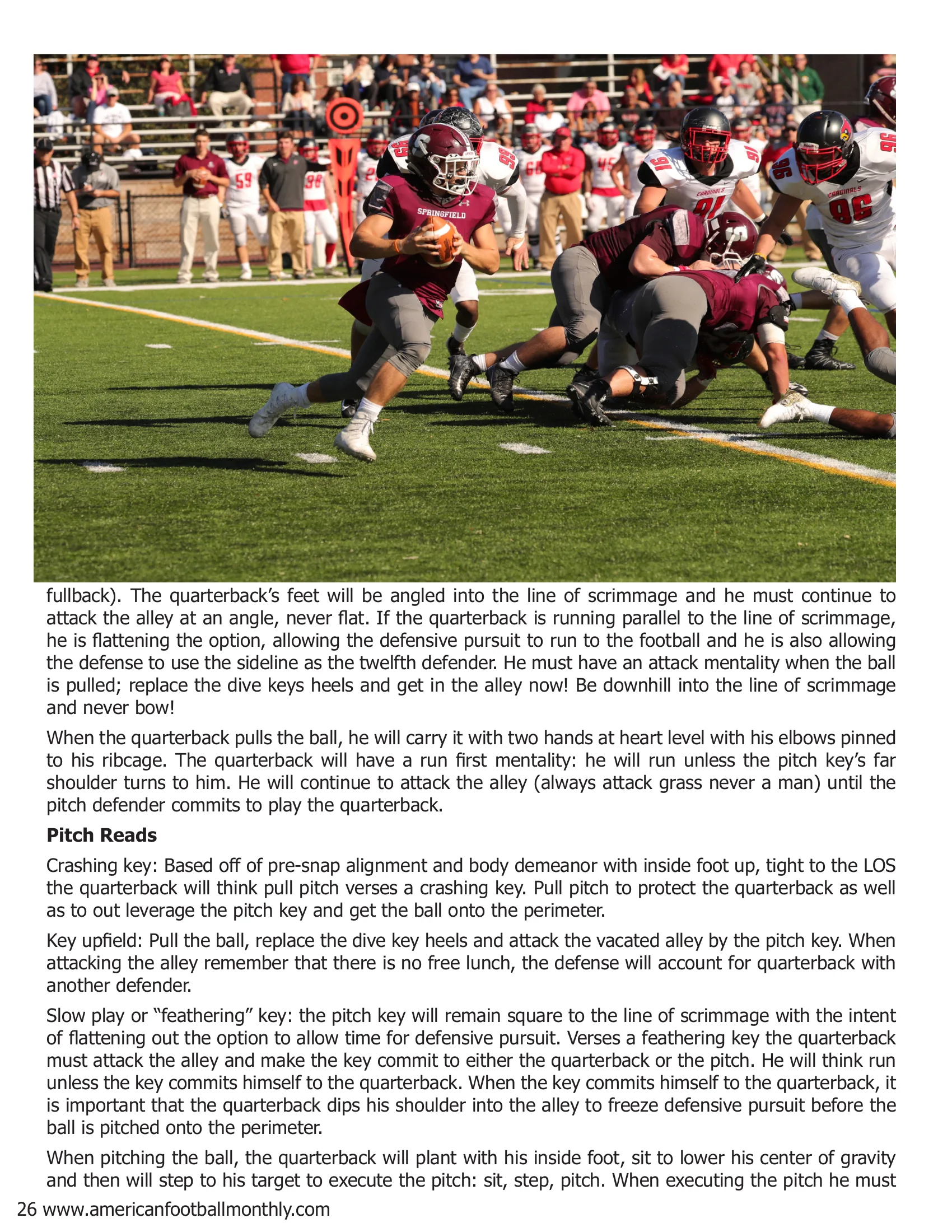
Page 2626 fullback). The quarterback’s feet will be angled into the line of scrimmage and he must continue to attack the alley at an angle, never flat. If the quarterback is running parallel to the line of scrimmage, he is flattening the option, allowing the defensive pursuit to run to the football and he is also allowing the defense to use the sideline as the twelfth defender. He must have an attack mentality when the ball is pulled; replace the dive keys heels and get in the alley now!
Be downhill into the line of scrimmage and never bow! When the quarterback pulls the ball, he will carry it with two hands at heart level with his elbows pinned to his ribcage. The quarterback will have a run first mentality: he will run unless the pitch key’s far shoulder turns to him. He will continue to attack the alley (always attack grass never a man) until the pitch defender commits to play the quarterback.
Pitch Reads Crashing key: Based off of pre-snap alignment and body demeanor with inside foot up, tight to the LOS the quarterback will think pull pitch verses a crashing key. Pull pitch to protect the quarterback as well as to out leverage the pitch key and get the ball onto the perimeter. Key upfield: Pull the ball, replace the dive key heels and attack the vacated alley by the pitch key. When attacking the alley remember that there is no free lunch, the defense will account for quarterback with another defender.
Slow play or “feathering” key: the pitch key will remain square to the line of scrimmage with the intent of flattening out the option to allow time for defensive pursuit. Verses a feathering key the quarterback must attack the alley and make the key commit to either the quarterback or the pitch. He will think run unless the key commits himself to the quarterback.
When the key commits himself to the quarterback, it is important that the quarterback dips his shoulder into the alley to freeze defensive pursuit before the ball is pitched onto the perimeter. When pitching the ball, the quarterback will plant with his inside foot, sit to lower his center of gravity and then will step to his target to execute the pitch: sit, step, pitch. When executing the pitch he must
Page 2727 be under control and in an athletic position. He will step to his target to shorten the pitch and recover a possible fumble. The quarterback must lead the pitch man so that he does not have to break stride and can explode through the pitch. The quarterback can manipulate both the pitch key and the defense by dipping his front shoulder into the alley to simulate that he is keeping the ball: dip and pitch. The quarterback must never pitch of the dive key and must never pitch under duress: NEVER, NEVER.
Coaching Points: • Replace the dive key’s heels • Attack the alley, never a man • Verses a crashing key pitch for leverage • There is no free lunch • Make the pitch key commit • Sit, step, pitch • Dip and pitch • Never pitch off the dive key • Never pitch under duress * QB does a good job of attacking grass versus a feathering pitch key. If there is green * QB is angled into the key rather than the alley.
This stems from him bowing out of the mesh instead of replacing the dive key heels and attacking the alley. * Although the QB has a far shoulder and he is pitching for leverage, he is running grass take it, attack the alley and go! parallel to the LOS. This allows for defensive pursuit to track down the running back for no gain. If he had replaced the dive keys heels and attacked the alley he would be running for daylight between #90 (FB) and #58 (LT). * QB’s answer to this picture: coach I am pitching for leverage.
Yes, he has out leveraged the pitch key; however, this picture illustrates why we need an attack first mentality. If the QB had put his foot in the ground and attacked grass this would have been an explosive play. * Good execution of a downfield pitch. He dips into the alley to freeze the defense and have the pitch key commit himself. But a poor pitch relationship by the running back: we want to be one yard deep and four yards in front.
Conclusion It is important to note that these techniques and philosophies have been developed over the past thirty years of Springfield College running option football. The foundation of these philosophies and techniques were started with Coach DeLong, Coach Manello and Coach Anderson, continued with Coach Mckenney and current head coach Mike Cerasuolo, as well as years of former graduate assistants.
Springfield College has also benefited greatly from years of visiting with and gathering new ideas from other option schools. If anyone reading has any further questions or would like to talk in more detail about this topic please feel free to contact me by email at gwebster@springfieldcollege.edu .