Our base defensive front is 4-3 with quarters coverage behind it. We flip our entire defensive front, which enables us to easily add some 46 and 3-4 looks to our package. Also, playing some man-free allows the ability to walk another man into the box in a manner that is a little different from your basic 8-man front. We spend a lot of time on teaching all of our defensive front fundamentals from our 4-3 front and build off of it to get to the other fronts. In our 4-3 front, we allow our players to make several adjustments and gap exchanges based on formations. We keep declaration rules extremely simple and have the adjustments built into our system if we do misdeclare. Therefore, front declaration has not been a problem for us to date.
Once we have taught our base front and coverage, we begin to teach individual stemming to all 11 players. We never want to give the same look two consecutive plays, although we may have the same defensive responsibilities for several straight plays. By changing one player's alignment, slanting one lineman, walking linebackers into the gaps, allowing players to move around in alignment (including defensive linemen), standing one or possibly 2 defensive linemen up or a combination of any of these, we can really create confusion among quarterbacks and offensive linemen. We coach our players to create confusion and indecision among offensive linemen, then to be aggressive and attack on the snap. We feel it gives us a chance to possibly survive with some average players. We also want to make it as tough as possible for a quarterback to audible the run game, or pass protection based on a good look at our defensive alignment.
Front Terminology
Prowl - All players are allowed to align one full man from there called alignment in the front and move back to their correct alignment prior to the snap on slant to it on the snap.
Gouge - Gap exchange for 3 Tech. Slant to strong A gap.

Diagram 1
Tear - Gap exchange for 5 Tech. Slant to B gap.

Diagram 2
Bluff - Linebackers walked up in their gap of responsibility.

Diagram 3
MUG- Middle linebackers walked up to cover the uncovered inside offensive line.

Diagram 4
NOB - Nose stands up- prowls around and blitzes his gap on the snap.

Diagram 5
Flex - 3 Tech stands up- prowls around and blitzes his gap on the snap.

Diagram 6
FUN - Flex and NOB combined.

Diagram 7
We can combine these terms to get several looks. Here are a few examples:

Diagram 8

Diagram 9

Diagram 10
These are examples of different movements but still playing our 4-3 front. Obviously, we can also run all of our linebackers blitzes combined with tagging some of the calls to the blitz.
The next phase of our front package is to add in the other fronts of the 46 and 34, which fit nicely with the way we align our players in our base defense. We do very little out of these fronts, but they are a good change-up and, in game conditions, it is hard to distinguish when we are actually in them.
Tite
In our TITE pacakge, we have the following declaration and alignment rules:
WIDE RECEIVER TECHNIQUE
Declaration Rules:
1. T.E.
2. Receiver strength
3. Wide side
4. Left
Alignment Rules:
Rush - Go to call - align in a 9 tech on a TE if no TE align in 5 on tackle
Guard - Go to call - align in a 3 tech on the offensive guard
Nose - Shade away from the call
Tackle - Go away from the all - align in a 5 tech
Sam - Go with the call - align in a 70
Mike - Align in zero
Will - Go away from call - align stacked on tackle in a 50

Diagram 11. Base

Diagram 12. Tite I

Diagram 13. Tite 6

Diagram 14. Tite Under

Diagram 15. Tite Solid

Diagram 16. Tite Tough - 1 TE only

Diagram 17. Tite Gouge

Diagram 18. Tite Tear
Bear
Declaration Rules:
1. T.E.
2. Receiver strength
3. Wide side
4. Left
5. Could be predetermined by field, boundary, right, left
Alignment Rules:
Rush - Go to call - align 2 yards outside end man on LOS and cock in
Guard - Go to call - align in 3 tech
Nose - Head up on center
Tackle - Go away fromo call - align in 3 tech
SLB - Go with call - align head up on TE inside eye
MLB - Go with call - 40
WLB - Go away from call - align 2 yards outside end man on LOS
Strong Safety - 40

Diagram 19. Bear base

Diagram 20. Bear I

Diagram 21.Bear strong

Diagram 22. Bear tornado

Diagram 23. Bear angle

Diagram 24. Bear trade

Diagram 25. Bear weak
Steeler
In our Steeler front we blitz out of it. We have the following declaration and alignment rules:
Note: Odd numbers strong, even numbers weak
Declaration Rules:
1. T.E.
2. Receiver strength
3. Wide side
4. Left
Alignment Rules:
Rush - Go to call - align loose 9 tech on TE, align on air if there is TE. Cover down.
Guard - Go to call - align head u pon offensive tackle (4 tech)
Nose - Align head up on center
Tackle - Go away from call - align head up on offensive tackle
SLB - Go with call - align in 20 tech
MLB - Go away from call - align in 20 tech
WLB - Go away from call - align in a loose 9 tech on a TE, align on air if there is no TE.

Diagram 26. Steeler base

Diagram 27. Ram 71

Diagram 28. Ram 72

Diagram 29. Ram 74

Diagram 30. Wasp 82

Diagram 31. Wasp 81

Diagram 32. Wasp 83

Diagram 33. Ram 31

Diagram 34. Ram 32

Diagram 35. Wasp 42

Diagram 36. Wasp 41

Diagram 37. Smoke 13

Diagram 38. Mash 24

Diagram 39. Trick 24

..
Diagram 40. Gamble 13

Diagram 41. War 87

Diagram 42. Switch
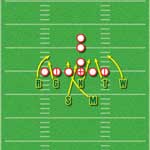
Diagram 43. Blitz 17
Okie
We teach our defensive linemen a gap control technique from an inside shade and an outside shade, a slant technique, and a blitz technique (NOB, FLEX). We teach our linebackers to read backs to offensive linemen and to fit off the defensive line. No matter what the front call these are the only techniques and reads we need.
The last phase of our defensive fronts is to play man free and to put the man responsible for the tight-end in a 7 technique, we call it a stick technique, so as to have a C gap run defender and to deny a tight-end the ability to free release in the passing game.

Diagram 44. Stick technique
Once again we will add all of our tag calls to this so as to create another set of headaches for the offensive line and quarterback.
Key Coaching Points
Defensive Line - We teach our defensive linemen to put their man hand on the ground, so their stance is determined by the shade they are aligned. When prowling we want them to quickly switch hands and keep their toes square to the line of scrimmage. The players will usually have a favorite direction they like to prowl. We don't care which direction they move as long as they can still see the ball and their toes are square. We want them to understand that they are to always be in a good stance and be prepared to get off of the ball regardless of alignment. In the NOB and FLEX technique we want the defensive linemen who is standing up to in essence blitz his gap of responsibility. We coach them the same way we coach a linebacker blitzing an inside gap, we want them to attack the gap at full speed on the snap (hopefully timing snap), we want them to flip their hips, keep their numbers down and to club and rip through the gap and have the ability to redirect to the ball. They have to understand that the gap may move on the snap and they will have to change their path. We want penetration through the gap versus any type of individual block and we want the line of scrimmage to change in our favor versus a double team (although we don't get doubled a lot in this technique).
Linebackers
We spend time on coaching our linebackers on playing from 3 positions.
1. Normal position - We teach our players to take a stance that has their feet square and directly underneath their hips. We want a slight forward lean with the numbers over the toes with a comfortable bend in the hips and knees. We want a 6" 45 degree directional step to be their first movement mirroring their key (back).
2. Prowl position - We tell our linebackers that we want then to always keep the shoulders over the toes, numbers down, feet square and underneath the arm pits, and NEVER cross the feet as they prowl. The other critical thing is to always expect a good first step on the snap and this should be possible if they prowl correctly.
3. Bluff position - We have a linebacker in a bluff or mug position to take a heel to the stagger in his stance with his inside foot up. We tell them that if they are blitzing the snap to put 75% of their weight on the ball of the front foot and to roll over that foot on the snap. If they are not blitzing then it is basically reversed. We have them put 75% of their weight o the back foot and to roll over that foot on the snap and to read their keys as normal.
Practice Organization and Drills
We spend a 10 minute segment on our defensive practice on all of our various movements. We do it with trash barrels as the offensive line and kickers as the offensive skill guys. We can do this regardless of our scout team situation, at the beginning or end of practice, or in the middle of team to give our scouts a rest. During pre-season practice it can also be a time to get a blow physically but we really expect proper technique, good stance and proper eye location. This is a time where the coaches can really correct and teach detail. We can also teach our players some looks that particular offenses might not want to see or some illusions that we want to create. I believe it is important that we don't call this 10 minute segment a "walk-thru." Our players tend to not be as mentally crisp in a walk thru so we call it our "Prowl and Disguise Period." We script it and get a lot of reps on prowl technique.
We work on prowling with the defensive line in one on one versus the offensive line. This is a great opportunity to work on switching hands in the stance with the defensive line coach getting a chance to pay close attention to stance and get-off.
We "walk-thru" prowl technique with all positions in pre-practice just to teach body position, stance, and footwork. We do a lot of our key drills with linebackers in a bluff position.
We work on our Nob and Flex technique against dummies or sleds a lot so as to cut down on some collisions. The offensive linemen tend to take a big hit in these situations and we try to save those for the other guys as much as possible.
Philosophy
We believe that this style of defensive front play allows us to really take away some of the execution of the opposing offensive line. We feel we create some busted assignments and take away blocking angles by moving around. With so much of what the offense does being determined by the alignment of the defense we think this challenges the offense's comfort zone.
Our coaches and players really enjoy this style of defense and I believe it lends itself to getting better pursuit and more aggressive play. There is no question that we don't get blocked as much as if we just lined up and played one final note, be sure to alert your head coach before you stand your two inside defensive linemen up and prowl them around. To your traditional defensive purist this is blasphemy and it is not something you want to spring on the faint-hearted.
Every Issue. Every Article. Free.
American Football Quarterly is now free for every coach — no subscription, no login. Browse all the issues, or get each new edition by email.